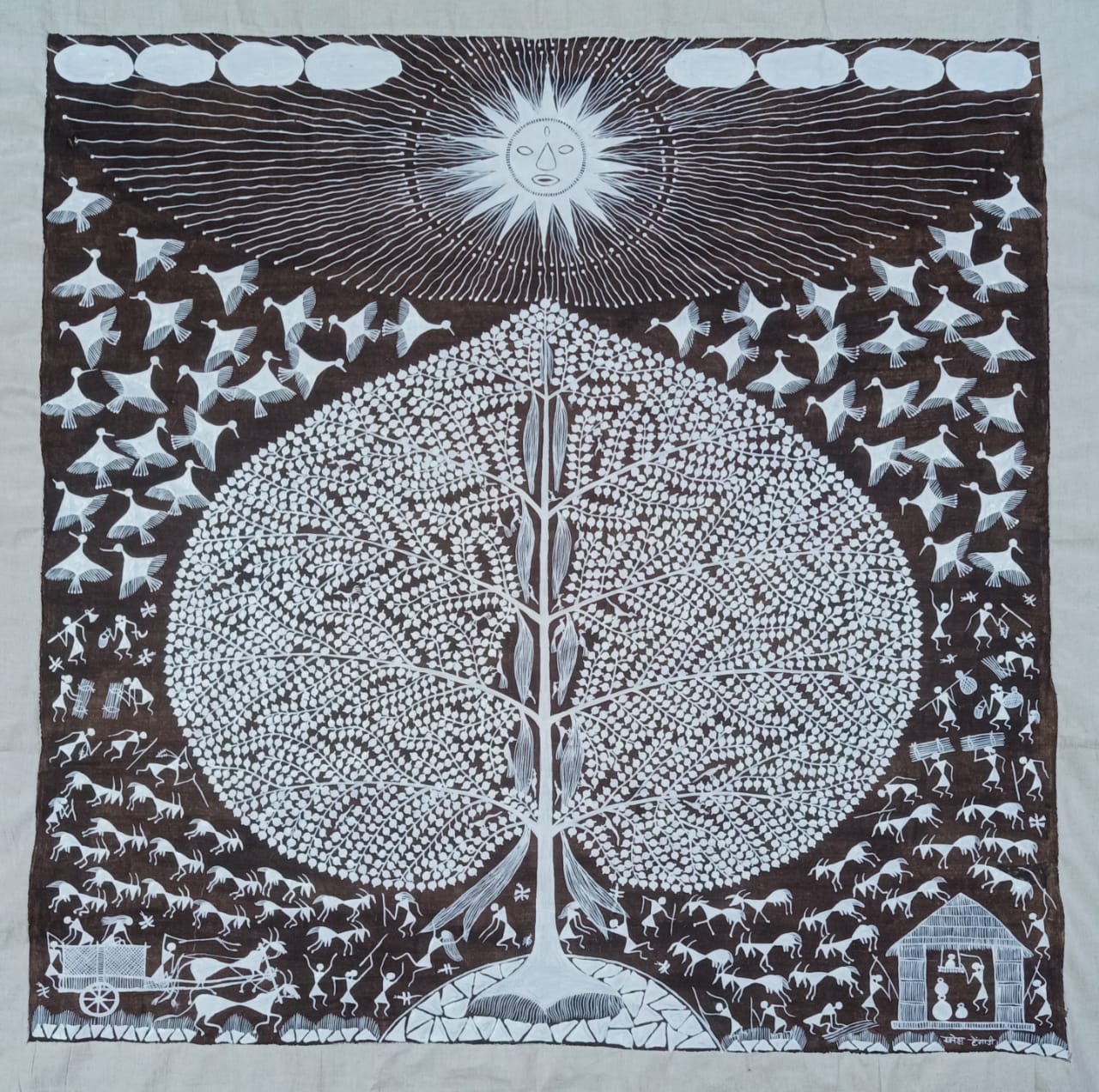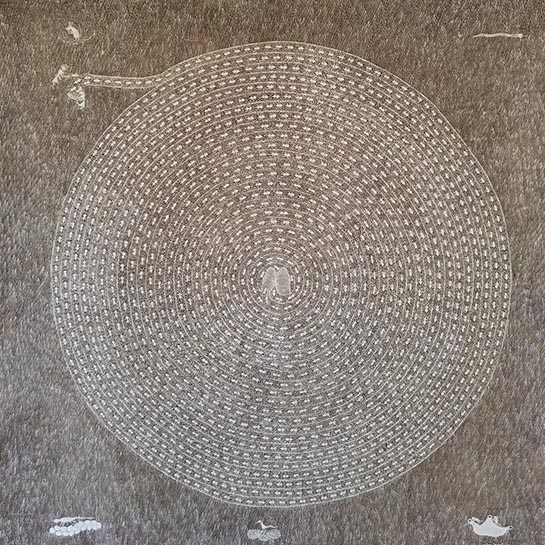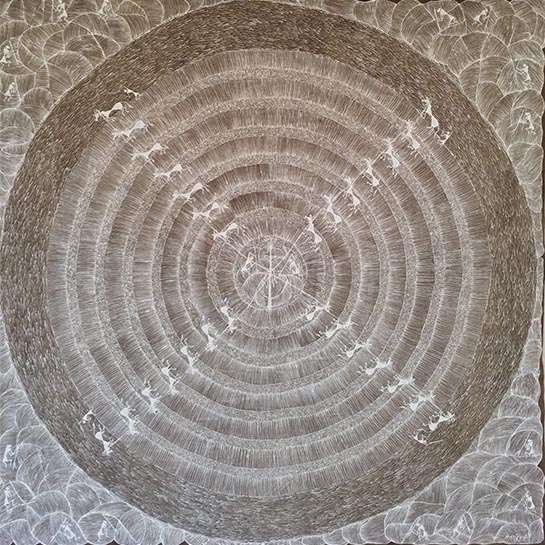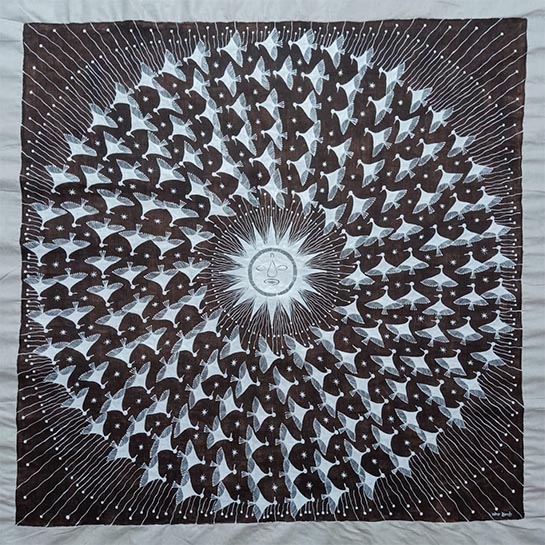

Warli painting is a distinctive visual tradition practised by the Warli tribe, one of the largest tribal communities in the state of Maharashtra. Shaped by an agrarian way of life and a close relationship with the natural environment, Warli painting is both a ritual practice and a visual expression of the community’s cosmology.
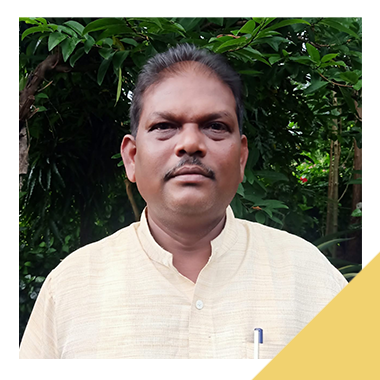
Ramesh Laxman Hengadi (b. 1976) is a Warli artist whose practice is deeply grounded in this inherited cultural vocabulary. Hengadi grew up observing the ritual paintings created during village ceremonies and festivals with these early experiences shaping his understanding of Warli visual traditions. Traditionally executed on mud walls prepared with red ochre or cow dung, Warli paintings are created in white pigment made from ground rice paste mixed with water and natural gum. Using a bamboo stick as a brush, artists construct figures through rhythmic sequences of dots and dashes rather than continuous lines. Human forms appear as stylised figures composed of two inverted triangles joined at their apex, symbolising the fragile balance between the human body and the forces of nature. These compositions frequently depict scenes of agricultural labour, hunting, communal gatherings, and ritual celebrations, reflecting the rhythms of everyday life in Warli society.
A recurring motif within Warli painting is the circular formation of figures performing the Tarpa dance, in which men and women move in spiralling patterns around a musician playing the tarpa wind instrument. This motif symbolises continuity and cyclical time, embodying the Warli understanding of life as an unending cycle encompassing birth, marriage, and death.
Alongside his artistic practice, Hengadi has played an important role in promoting Warli art through workshops, exhibitions, and educational initiatives. He has conducted training programmes for students and participated in numerous exhibitions and cultural events across India and internationally, including residencies and exchanges with institutions such as the Harley Foundation in the United Kingdom (2008) and collaborative programmes with the Victoria and Albert Museum, London (2016). Through his work, Hengadi continues to sustain and reinterpret the visual language of Warli painting while advocating for the preservation of tribal cultural traditions and community education.