
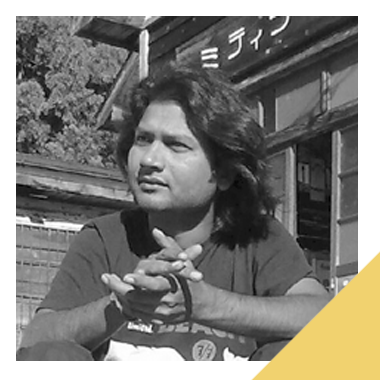
Born into a Patua family in rural West Bengal, Anwar Chitrakar was trained in the traditional art of narrative scroll painting (pats). In this tradition, long vertical scrolls arranged in descending panels depict a series of continuous narratives, often drawn from the lives of Krishna, the adventures of Rama, and other local or popular stories. The scrolls are not primarily produced for sale but serve as performative tools that accompany the patua’s role as an itinerant singer and entertainer. Travelling within a radius of ten to fifteen miles from their villages, patuas perform in bazaars, temple courtyards, schools and homes, gathering audiences around them. As the patua sings the depicted story in rhymed couplets, he gradually unrolls the scroll, revealing each scene in sequence, synchronising the images with his sung performance.
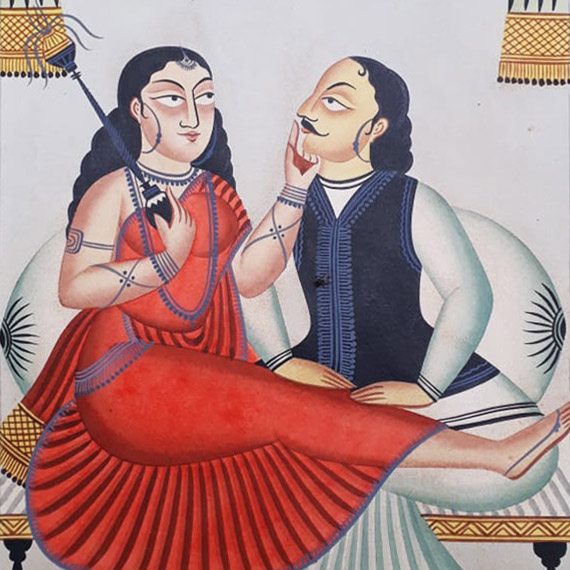
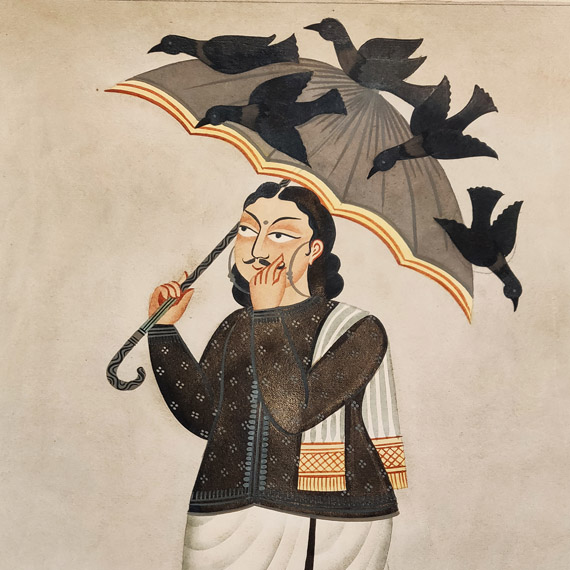
Alongside this rural scroll painting tradition, Anwar was introduced to the genre of Kalighat painting, which had emerged in 19th century colonial Calcutta. Although Kalighat painting had developed stylistically from Patua scroll paintings, it simultaneously absorbed a range of artistic influences characteristic of the colonial urban milieu, including photography, the works of European and academically trained Indian artists, and the expanding visual culture of the printing press. Distinguished by bold, expressive figures, simplified forms, and vibrant natural colours, Kalighat paintings traditionally were painted on loose sheets of paper or cloth for devotional, narrative, and commercial purposes.
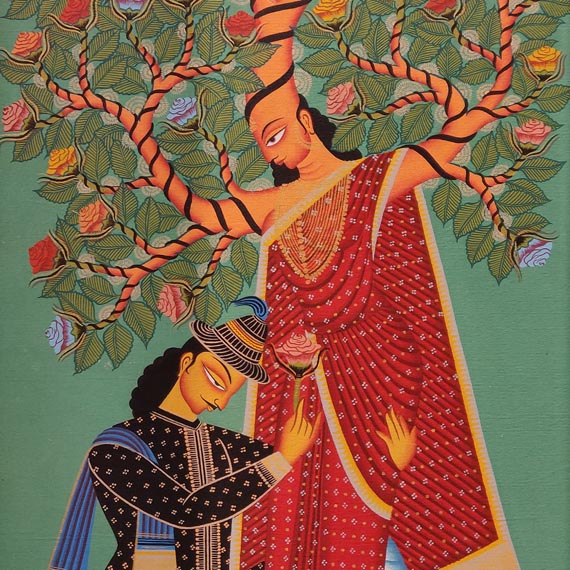
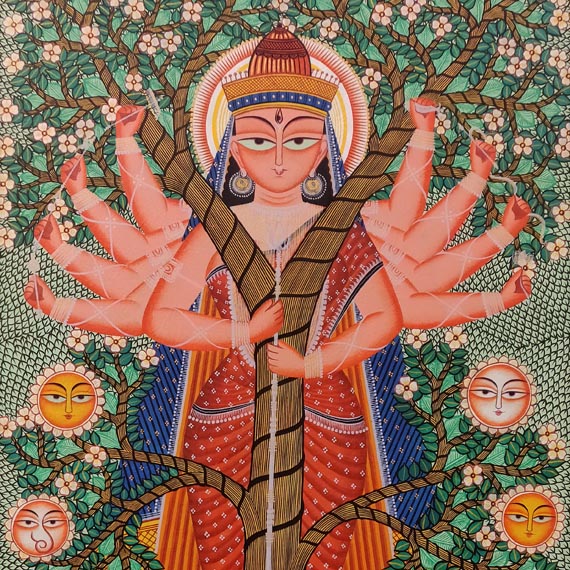
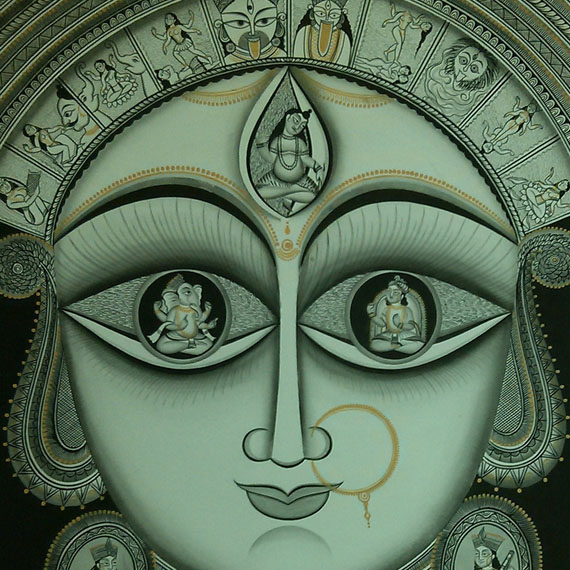
Anwar’s artistic practice brings together these two distinct yet complementary visual traditions: the narrative, performative storytelling of Patua scrolls and the fluid, expressive idiom of Kalighat painting. This synthesis shapes a practice that is both distinctly personal and socially responsive, engaging with urgent contemporary issues such as the COVID-19 pandemic, ecological degradation, child marriage, gender inequality, and labour migration. Reflecting the historical trajectory of Kalighat painting, his work shifts seamlessly between representations of Hindu deities and mythological narratives and scenes rooted in everyday life. Portrayals of public figures, quotidian experiences, and genre scenes are infused with a keen sensitivity to social conditions, often articulated through satire and metaphor. In this way, Anwar maintains an active dialogue with popular visual and literary culture, extending the critical and communicative legacy of these traditions into the present. Anwar continues to prepare natural pigments using turmeric, marigold and lamp soot with tree gum as a binding agent, while expanding the formal possibilities of his artistic practice through works on canvas.
His work has been widely exhibited in India and internationally, including the Berlin Festival (2012), Namaste India Festival, Japan (2012), and Devi Art Foundation’s Vernacular in the Contemporary (2010) New Delhi), the Mumbai Art Fair (2024) and the Jehangir Art Gallery, Mumbai (2017, 2024). His paintings are held in major collections, notably the Victoria and Albert Museum, London and the CSMVS, Mumbai. He has received several honours, including the Rabindra Bharati University Award (2003), West Bengal State Award (2002), National Award (2006), and the President’s Award (2006).